

The calendar brings the January Employment Report, fresh reads on ISM activity, and a second wave of mega-cap and consumer earnings. Policy headlines around the budget path, Treasury supply, and oil also factor into yields and risk appetite. Below is a concise, web-friendly guide to what matters now—and what could move markets next.
Jobs, Yields, and Market Breadth in Financial News
Jobs week often sets the tone. Payrolls, unemployment, and wage growth shape rate expectations and the yield curve. Softer—but steady—labor data typically supports the “soft landing” view. Hot wage prints can complicate inflation progress.
- Payrolls: Moderate job creation reduces pressure on policy while supporting growth.
- Unemployment: A stable rate helps balance demand with disinflation.
- Wages: The key input for services inflation and rate expectations.
- Participation: Higher participation can ease wage pressure at the margin.
Bond yields tend to react first. Cooler wage growth can pull long yields lower, supporting housing, utilities, and select REITs. Stickier wage inflation can keep higher-for-longer in the conversation, preserving the carry advantage of cash and short Treasuries.
ISM Manufacturing and ISM Services update orders, hiring, and pricing power. A mix of modest growth and easing prices helps duration regain a defensive role. That backdrop can broaden equity participation beyond a narrow leadership cohort. Under the surface, markets continue to reward free cash flow, margin discipline, and clean capital allocation—hallmarks of quality in this phase of the financial news cycle.

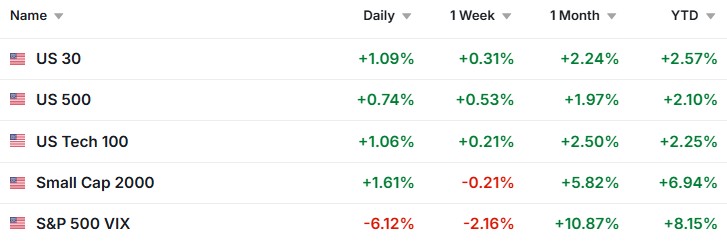
US Market Performance – Week Ending 1/30/2026
Policy Crosscurrents, Oil, and Earnings in Financial News
Politics is not the whole story. It still steers parts of it. Government funding steps and deficit dynamics influence Treasury issuance and the term premium. A smoother budget path tends to calm long-end volatility and support risk appetite. A noisier path can keep yields sticky and multiples restrained.
Energy is the swing factor. OPEC+ signals and U.S. inventory trends can move crude. Oil swings filter into headline inflation and, in turn, rate expectations. That feedback loop touches transportation, refiners, airlines, and consumer purchasing power. The practical takeaway is straightforward: balance selective growth with quality income and keep some intermediate duration as a cushion against downside growth surprises.
Earnings remain a driver of day-to-day moves. Markets continue to favor companies showing recurring revenue, durable free cash flow, and operating leverage. AI, cloud, and data infrastructure spending still matter, but monetization beats mere ambition. Policy chatter around tech regulation, data privacy, and AI governance can also shape valuation ranges. Diversification across size, style, and sector reduces single-policy risk—a useful habit when the financial news can change before lunch.
This Week: Key Economic Data
Monday: ISM Manufacturing Index (Jan); S&P Global Manufacturing PMI (final, Jan); Construction Spending (Dec)
Tuesday: Job Openings and Labor Turnover Survey (JOLTS, Dec); Factory Orders (Dec)
Wednesday: ADP National Employment Report (Jan); ISM Services Index (Jan); S&P Global Services PMI (final, Jan)
Thursday: Weekly Jobless Claims; Productivity & Costs (Q4 prelim); U.S. Trade Balance (Dec)
Friday: Employment Situation (Jan): Nonfarm Payrolls, Unemployment Rate, Average Hourly Earnings; Consumer Credit (Dec)
This Week: Companies Reporting Earnings
The following US based companies are reporting earnings this week:
- Disney (DIS)
- Palantir (PLTR)
- Tyson Foods (TSN)
- IDEXX Laboratories (IDXX)
- Simon Property Group (SPG)
- Teradyne (TER)
- Advanced Micro Devices (AMD)
- PayPal (PYPL)
- Pfizer (PFE)
- PepsiCo (PEP)
- Merck (MRK)
- Chipotle Mexican Grill (CMG)
- Amgen (AMGN)
- Electronic Arts (EA)
- Alphabet (GOOGL/GOOG)
- Uber (UBER)
- Eli Lilly (LLY)
- Qualcomm (QCOM)
- AbbVie (ABBV)
- Boston Scientific (BSX)
- Snap (SNAP)
- Amazon (AMZN)
- MicroStrategy (MSTR)
- Roblox (RBLX)
- Bristol-Myers Squibb (BMY)
- ConocoPhillips (COP)
- Fortinet (FTNT)
- Cardinal Health (CAH)
- Biogen (BIIB)
- Centene (CNC)
- Under Armour (UAA/UA)

Tax Tip: 529-to-Roth IRA Rollovers—Repurpose Leftover College Savings
Some unused 529 plan funds can be rolled over to a beneficiary’s Roth IRA, within limits. The 529 must generally be open at least 15 years; recent contributions (and earnings on them) within the last five years are not eligible; rollovers count toward the annual IRA contribution limit; and there is a lifetime rollover cap (currently $35,000). This rule can help convert excess education savings into long-term, tax-advantaged retirement dollars. Confirm plan records, beneficiary eligibility, and timing before acting, and coordinate with a tax professional.
This information is not a substitute for individualized tax advice. Please consult with a qualified tax professional to discuss your specific tax issues.
Tip adapted from IRS.
Footnotes and Sources
- Bureau of Labor Statistics: Economic release calendar
- BLS: Employment Situation
- ISM: Manufacturing and Services Reports on Business
- ADP: National Employment Report
- U.S. Census: Manufacturers’ Shipments, Inventories, and Orders (Factory Orders)
- BEA/Census: International Trade in Goods and Services
- The Conference Board: Consumer Confidence Index
- U.S. Treasury: Daily yield curve and auction details
- U.S. EIA: Weekly Petroleum Status Report
- WSJ Markets: Earnings calendar
- CNBC Finance: Markets and financial news
- Bloomberg Markets: Global market data and analysis
- IRS: 529-to-Roth IRA rollovers—FAQs

Wesley Samson
Wesley@samsonfinancial.net
863-345-0538
Samson Financial, LLC.
https://samsonfinancial.net