

Expect lighter volumes, sharper moves, and plenty of focus on policy, oil, and the dollar. Treasury supply, budget headlines, and OPEC updates can sway yields and sector leadership. The calendar tilts toward housing and sentiment reports midweek, then pivots to manufacturing as the new year begins. Below is a concise, web-friendly rundown of what matters and how political and policy currents may steer the financial news narrative into early January.
Year-End Market Mechanics: Rebalancing, Liquidity, and the Dollar in Financial News
Late-December trading often exaggerates normal moves. Rebalancing, tax-loss harvesting, and cash housekeeping can push indices and sectors more than fundamentals alone. The dollar and commodities remain part of the story. Precious metals have been buoyed by geopolitical tension and a softer dollar at times, which can tighten financial conditions in some regions and loosen them in others, influencing risk appetite across asset classes. The net effect: choppier intraday ranges and swift rotations even on light headlines. Bloomberg and CNBC highlight that thin holiday tapes can magnify ordinary data surprises into bigger market reactions.
For equities, the market continues to reward quality. Companies showing recurring revenue, clean capital allocation, and durable free cash flow have commanded premium multiples. Those that miss on monetization or guide cautiously often see fast resets. That selectivity has defined the equity tone through the latest phase of the financial news cycle.
In fixed income, two forces compete: disinflation progress that supports easier long-end yields, and issuance/budget uncertainty that can keep the term premium sticky. A steadier path for rates tends to help housing-adjacent groups, utilities, and select REITs. Stickier inflation or supply concerns can preserve the carry advantage of cash and short Treasuries a bit longer. U.S. Treasury data and WSJ Markets continue to frame the crosscurrents.

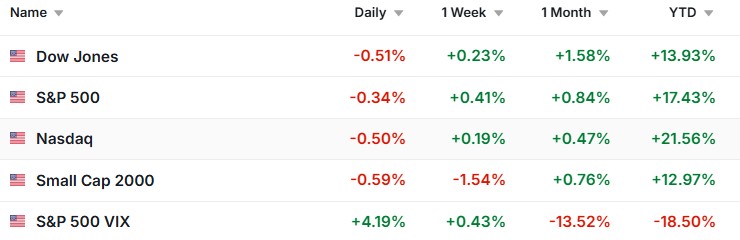
US Market Performance – Week Ending 12/26/2025
Policy, Oil, and Housing: How Politics Is Shaping Financial News Right Now
Politics is not the whole story. It does steer parts of it. Government funding debates and deficit dynamics influence Treasury auctions and the term premium. A smoother budget path generally calms long-end volatility; a noisier path can keep yields sticky, affecting mortgage rates, corporate borrowing costs, and equity valuation ranges. The policy channel is one reason markets keep a close eye on issuance calendars and fiscal headlines. CRS offers useful background on how budget mechanics filter into markets.
Energy adds a second lever. OPEC+ communications and U.S. inventory trends can swing crude oil. Those swings often leak into headline inflation and then back into rate expectations—creating a feedback loop that touches airlines, refiners, transport, and consumers’ purchasing power. OPEC press releases and the EIA’s weekly petroleum report remain important inputs for near-term rate and sector narratives.
Housing sits at the intersection of these currents. Slightly lower mortgage rates can support builder traffic and new-home demand, even as affordability stays tight. Upcoming reports on confidence, pending sales, and construction will help clarify if the recent easing in yields is translating into better housing activity. S&P CoreLogic Case‑Shiller and the Conference Board are in focus this week, alongside ISM and S&P Global PMIs that update the growth and pricing picture.
This Week: Key Economic Data
Monday: Light calendar; regional Fed manufacturing snapshots; year-end Treasury bill auctions
Tuesday: S&P CoreLogic Case-Shiller Home Price Index (latest monthly read); Conference Board Consumer Confidence (December)
Wednesday: Pending Home Sales (November); Chicago PMI (December); EIA Weekly Petroleum Status Report
Thursday: New Year’s Day (U.S. markets closed)
Friday: ISM Manufacturing Index (December); S&P Global Manufacturing PMI (final, December); Construction Spending (November)
This Week: Companies Reporting Earnings
No corporate earnings to report this week.

Start the New Year Right: Automate 2026 Retirement Contributions
A quick January tune-up can improve outcomes all year. Confirm workplace plan deferral settings, set an automatic increase, and review IRA eligibility for the new tax year. If age 50 or older, consider catch-up contributions. IRA contributions for the 2026 tax year can generally be made until the April 2027 filing deadline, but earlier funding captures more compounding. For current limits and rules, review the IRS “Retirement Topics” pages and coordinate with a tax professional to fit contributions within your broader cash-flow plan.
This information is not a substitute for individualized tax advice. Please consult with a qualified tax professional to discuss your specific tax issues.
Tip adapted from IRS.
Footnotes and Sources
- CNBC Finance: Markets and financial news
- Bloomberg Markets: Global market data and analysis
- Wall Street Journal: Markets and earnings coverage
- S&P CoreLogic Case‑Shiller Home Price Index
- The Conference Board: Consumer Confidence Index
- ISM: Manufacturing Report on Business
- S&P Global: PMI releases
- U.S. EIA: Weekly Petroleum Status Report
- OPEC: Press releases and meeting communications
- U.S. Treasury: Daily yield curve rates and auction details
- IRS: Retirement Topics – IRA Contribution Limits

Wesley Samson
Wesley@samsonfinancial.net
863-345-0538
Samson Financial, LLC.
https://samsonfinancial.net