
Stocks posted broad weekly losses as geopolitical risk in the Middle East escalated, chip stocks pulled back sharply on AI spending concerns, and trade policy uncertainty continued to cloud the earnings outlook. The S&P 500, Nasdaq, and Dow all finished in the red for the week. Yet beneath the surface, some important divergences are worth watching: Apple surged over 3.5% even as peers stumbled, Citi analysts called the chip selloff a buying opportunity, and Wall Street is already mapping out two very different paths for how U.S.-Iran tensions ultimately resolve. Here is a clear, web-friendly breakdown of what is driving financial news this week — and what it means for portfolios.
Chip Stocks Sell Off on AI Concerns — But Is This a Buying Opportunity in Financial News?
The semiconductor sector took the biggest hit this week. Micron Technology (MU) fell nearly 7%, Intel (INTC) dropped 7.89%, SanDisk (SNDK) plunged more than 10%, and AMD slipped 3.29%. Even NVIDIA, the AI infrastructure darling, gave back nearly 1% despite still sitting on massive year-to-date gains.
What triggered the pullback? A combination of forces. First, investor concern that AI data center capital expenditure may be growing faster than near-term demand can support — a debate that has been simmering for months. Second, tariff headlines targeting semiconductor supply chains have reignited worries about input costs and margin compression. Third, geopolitical tensions in the Middle East are adding a general risk-off tone that tends to hurt high-multiple, high-growth names first and hardest.
Not everyone is bearish. Citi analysts moved quickly to call the chip pullback a buying opportunity, noting that the long-term structural demand for AI compute remains intact. That view has merit — but it requires patience. Here is what the financial news context suggests investors should consider:
- Structural demand is not in question. AI infrastructure buildout across cloud providers, enterprise software, and defense applications is a multi-year secular trend. A quarter or two of choppy pricing does not change that calculus.
- Near-term earnings risk is real. If chip companies report weaker-than-expected forward guidance — particularly on data center orders — multiples could compress further before they recover.
- Quality differentiation matters. Not all chip companies are equal. Companies with diversified revenue streams, strong balance sheets, and proven monetization paths are better positioned to weather the volatility than pure-play speculative names.
- Apple’s divergence is telling. Apple surged 3.53% to $333.02 on heavy volume while chip peers sold off — a reminder that brand strength, services revenue, and ecosystem stickiness can insulate quality tech franchises from broader sector noise.
For the broader financial news picture, the semiconductor pullback is a useful reminder that even the strongest secular themes experience turbulence. Balanced exposure across the AI investment chain — hardware, software, cloud, and application layer — tends to smooth the ride better than concentrating in a single ticker or sub-sector.
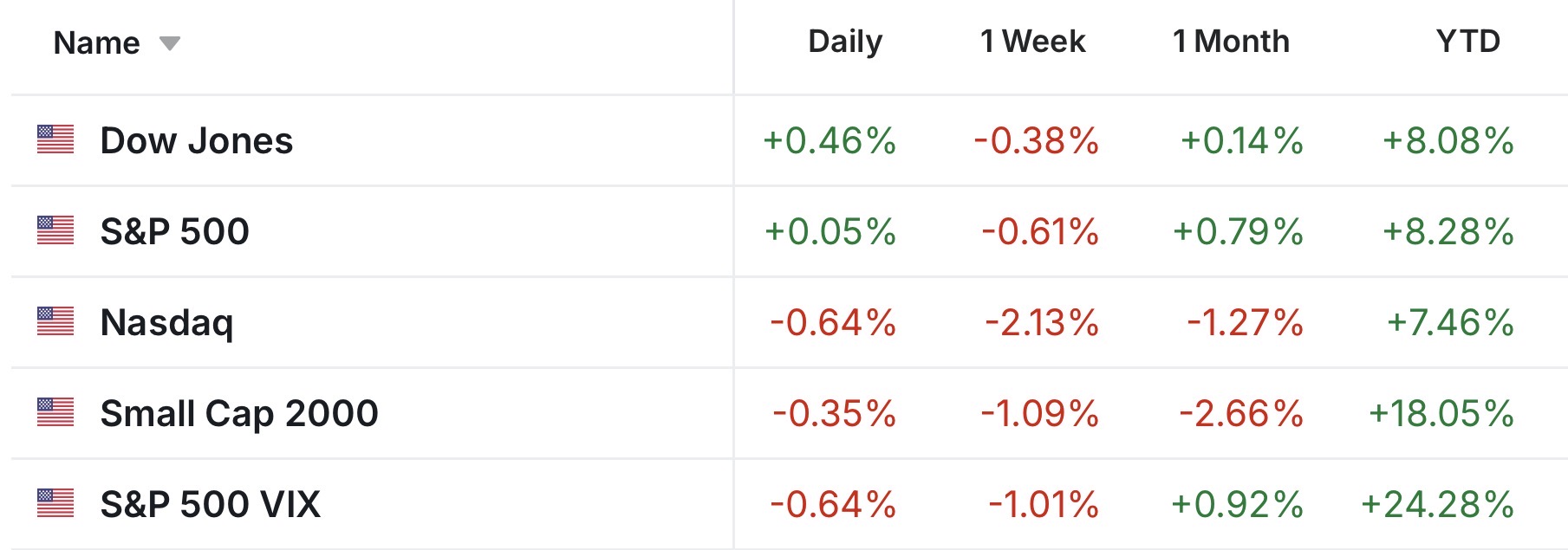
US Market Performance – Week Ending 7/24/2026
Iran Conflict and Tariffs: How Geopolitics Is Reshaping Financial News Right Now
The widening Iran conflict has moved from a background risk to a front-page market driver. Wall Street analysts are now actively mapping two distinct paths for how the situation unfolds — and each path carries meaningfully different implications for oil prices, inflation, and the Federal Reserve’s policy timeline.
Path one involves a contained, negotiated de-escalation. In this scenario, oil supply disruptions remain limited, headline inflation stays manageable, and the Fed retains its data-dependent flexibility. Risk assets could stabilize or recover quickly once the uncertainty clears.
Path two involves an escalation that draws in additional regional actors and disrupts key oil shipping routes — particularly the Strait of Hormuz, through which roughly 20% of global oil supply flows. In that scenario, crude prices could spike meaningfully, headline inflation would re-accelerate, and the Fed’s already patient posture on rate cuts would become even more constrained.
Layered on top of geopolitical risk, tariff headlines are adding a second layer of uncertainty. Trade restrictions targeting key technology and manufacturing supply chains are influencing sector earnings expectations and adding to inflationary pressures that the market had hoped were fading. Here is how these political and policy forces are filtering into key financial news areas:
- Energy: Crude oil prices are a direct function of Middle East risk. A supply disruption scenario would be strongly bullish for domestic producers and refiners — but bearish for consumers and inflation-sensitive sectors.
- Defense and aerospace: Geopolitical escalation has historically been a tailwind for defense spending and related contractors. That sector merits attention as a portfolio hedge.
- Technology and semiconductors: Tariff risk is most acute for companies with significant manufacturing exposure in Asia. Supply chain diversification and geographic revenue mix will matter for earnings guidance.
- Bond markets: A geopolitical-driven oil spike that reignites inflation could keep Treasury yields elevated and delay the rate-cut timeline — a headwind for duration-sensitive portfolios.
The practical takeaway for diversified portfolios in this financial news environment: avoid over-concentrating in any single geopolitical outcome. Quality income, selective growth exposure, and some intermediate duration as a cushion all remain relevant tools for navigating a market that is simultaneously dealing with AI growing pains, trade friction, and Middle East uncertainty.
This Week: Key Economic Data
Monday: Pending Home Sales (June); Dallas Fed Manufacturing Activity (July); Treasury bill auctions
Tuesday: S&P CoreLogic Case-Shiller Home Price Index (May); FHFA House Price Index (May); Conference Board Consumer Confidence (July); Job Openings and Labor Turnover Survey (JOLTS, June)
Wednesday: ADP National Employment Report (July); Federal Reserve policy decision and press conference; EIA Weekly Petroleum Status Report
Thursday: Weekly Jobless Claims; Advance estimate of Q2 Gross Domestic Product (GDP); Employment Cost Index (Q2); Federal Reserve balance sheet
Friday: Personal Income & Outlays (June) with PCE Price Index; University of Michigan Consumer Sentiment (final, July); Employment Situation Report — Nonfarm Payrolls, Unemployment Rate, Average Hourly Earnings
This Week: Companies Reporting Earnings
One of the heaviest weeks of Q2 earnings season is here, featuring mega-cap tech, consumer, energy, and pharmaceutical giants all reporting results.
- Apple (AAPL)
- Amazon (AMZN)
- Meta Platforms (META)
- Microsoft (MSFT)
- Alphabet (GOOGL)
- ExxonMobil (XOM)
- Chevron (CVX)
- Merck (MRK)
- Pfizer (PFE)
- Mastercard (MA)
- Caterpillar (CAT)
- McDonald’s (MCD)

Tax Tip: Mid-Year Capital Gains Review — Manage Your Tax Bracket Before Year-End
With the market experiencing meaningful volatility and sector rotation, mid-summer is one of the best windows of the year to review unrealized gains and losses in taxable accounts. The IRS taxes long-term capital gains — on assets held more than one year — at preferential rates of 0%, 15%, or 20% depending on taxable income. Short-term gains are taxed at ordinary income rates, which can be significantly higher. A few practical moves to consider now in consultation with a tax professional:
- Tax-loss harvesting: Use losses in underperforming positions to offset realized gains elsewhere in the portfolio. Just watch the 30-day wash-sale rule — repurchasing a substantially identical security within 30 days before or after the sale disallows the loss.
- Holding period check: If a position is approaching the one-year mark, waiting to sell could shift the gain from short-term (ordinary income rates) to long-term (preferential rates) — a potentially significant tax difference.
- Bracket management: Know where taxable income stands year-to-date. Selling appreciated positions strategically — or deferring sales into the next year — can prevent crossing into a higher tax bracket unnecessarily.
This information is not a substitute for individualized tax advice. Please consult with a qualified tax professional to discuss your specific tax issues.
Tip adapted from IRS.
Footnotes and Sources
- Investing.com: Stocks post weekly losses amid widening Iran conflict, AI worries, and tariffs (July 25, 2026)
- Investing.com: Pullback in chip stocks is a buying opportunity, Citi says (July 24, 2026)
- Investing.com: Wall Street sees only two paths for Trump in the Middle East (July 24, 2026)
- CNBC Finance: Markets and financial news
- Bloomberg Markets: Global market data and analysis
- Wall Street Journal: Markets and earnings coverage
- WSJ Markets: Q2 Earnings calendar
- Federal Reserve: FOMC calendar, statements, and press conferences
- Bureau of Economic Analysis: Economic release schedule (GDP; Personal Income & Outlays/PCE)
- Bureau of Labor Statistics: U.S. economic release calendar (Employment Situation; ECI)
- The Conference Board: Consumer Confidence Index
- S&P CoreLogic Case-Shiller Home Price Index
- U.S. EIA: Weekly Petroleum Status Report
- U.S. Treasury: Daily yield curve rates and auction details
- IRS Tax Topic 409: Capital Gains and Losses
- IRS Publication 550: Investment Income and Expenses (including wash-sale rules)

Wesley Samson
Wesley@samsonfinancial.net
863-345-0538
Samson Financial, LLC.
https://www.samsonfinancial.net