
This week’s financial news opens a high-stakes stretch of September: Labor Day markets are closed Monday, August inflation data arrives Thursday and Friday, and the FOMC meets September 15–16. The question is no longer whether a rate cut is imminent. After a stronger-than-expected August jobs report and a hawkish Jackson Hole speech from Fed Chair Kevin Warsh, investors are weighing a hold against the possibility of a hike.
Markets enter the week with the 10-year Treasury near 4.78%, the 30-year around 5.24%, gold still holding above $4,400 after its late-August pullback, and WTI crude near the high $80s to low $90s. The federal funds target remains 3.50%–3.75%. AI monetization, fiscal supply, and energy prices remain the background crosscurrents. Below is a clear breakdown of what the financial news means for markets and portfolios this week.
September FOMC Preview: Hold, Hike, or Still Waiting?
The September Federal Reserve meeting — September 15–16, with the decision at 2:00 p.m. ET on Wednesday the 16th — is the most consequential FOMC event of 2026 so far. It includes the Summary of Economic Projections and the dot plot.
Chair Warsh’s Jackson Hole address on August 28 was closely watched — and it was not a green light for cuts. He acknowledged that recent CPI and PCE readings were better than feared, then drew a hard line: those prints “do not tell me that underlying trends have meaningfully improved.” His test was confidence that inflation is moving to 2% “clearly and at sufficient speed.” Otherwise, he said, “we have work to do.” Markets read that as hawkish. Hike odds rose into Labor Day weekend.
Last Friday’s August Employment Situation added to that tension. Nonfarm payrolls rose 162,000 — well above the softer print many had hoped would ease wage pressure — and the unemployment rate held at 4.1%. That was the last major labor report before the meeting. What remains is inflation.
The setup heading into September 16:
- Services and shelter inflation are still the Fed’s problem children. Goods have cooled; wages, medical services, and housing have not fully cooperated with a 2% target.
- August PPI lands Thursday. August CPI lands Friday. Those two reports are the last major price data the Committee will have in hand. A firm core print keeps a September hike on the table. A clean downside surprise would argue for another hold.
- The 10-year near 4.78% and the 30-year above 5.20% still embed a term premium. Part of that is inflation risk. Part of it is fiscal supply.
- Fed communication is limited as the pre-meeting blackout approaches. Tone from any remaining regional-president remarks will matter less than Thursday–Friday inflation.
A well-telegraphed hold keeps cash and short-duration Treasuries useful and leaves rate-sensitive assets in a wait-and-see tape. A hike would pressure high-multiple growth and housing-linked names. Either way, quality — recurring revenue, margin discipline, and clean capital allocation — remains the more reliable guide than a one-meeting binary bet.
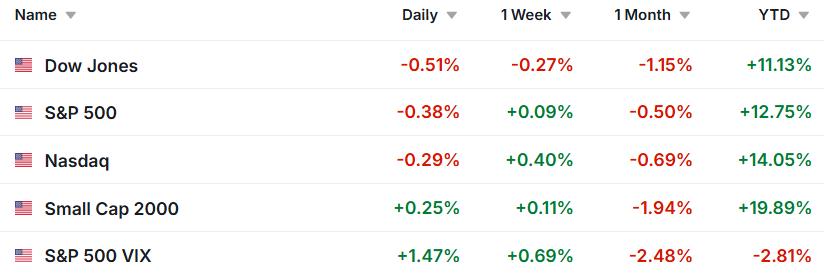
US Market Performance – Week Ending 9/4/2026:
Fiscal Crosscurrents and September Market Dynamics
Congress is back after the August recess with a full fall calendar. Continuing appropriations, deficit trajectory, and Treasury issuance still feed the term premium that has kept the long end sticky all summer.
The 30-year holding above 5.20% is not only an inflation story. Trillion-dollar deficits and rising debt-service costs mean buyers want extra yield. Until there is a more credible medium-term fiscal signal, that premium is likely to stay.
How that filters into this week:
- Treasury supply and auctions. Weak demand at a longer-dated auction can lift yields and ripple into high-multiple growth stocks.
- AI regulation. As Congress reconvenes, early governance and data-privacy language is worth watching for large-cap tech cost structures and multiples.
- Energy. WTI near the high $80s / low $90s is a live inflation input. An OPEC+ surprise or a Middle East disruption can move crude quickly and complicate Friday’s CPI read-through into the FOMC.
- Gold. Prices remaining above $4,400 after the late-August pullback still look like a fiscal-and-purchasing-power hedge, not a trade that sophisticated holders have abandoned.
Practical positioning for the open of September: balance selective growth with quality income, keep some intermediate duration as a cushion if growth data disappoints, and avoid treating September 16 as a single-outcome wager.
This Week: Key Economic Data
Monday, September 7: Labor Day. U.S. markets closed. Light international calendar.
Tuesday, September 8: Consumer Credit (July); NFIB Small Business Optimism.
Wednesday, September 9: Light U.S. calendar.
Thursday, September 10: Producer Price Index (August); weekly jobless claims; existing-home sales (August); wholesale inventories; EIA petroleum status.
Friday, September 11: Consumer Price Index and real earnings (August); University of Michigan consumer sentiment (preliminary, September); monthly Treasury statement.
The September 15–16 FOMC, retail sales, and the next jobs report sit in the following weeks.
This Week: Companies Reporting Earnings
The post–Labor Day earnings calendar is lighter, but a few software and consumer names still offer an early read on demand and margins.
- GameStop (GME) — Tuesday after the close
- Chewy (CHWY) — Wednesday
- Oracle (ORCL) — Thursday after the close
- Adobe (ADBE) — Thursday after the close
- Kroger (KR) — Friday before the open
Also on the radar: Casey’s (CASY), Macy’s (M), Copart (CPRT), and AeroVironment (AVAV). This is not a mega-cap tech week beyond Oracle and Adobe.

Tax Tip: September 15 Estimated Tax Deadline — Don’t Miss the Q3 Payment
The third quarterly estimated tax payment is due Tuesday, September 15. Summer bonuses, RSU vests, capital gains, and freelance income can all create a gap that withholding alone does not cover.
To stay inside the IRS safe harbor, pay at least 90% of this year’s total tax, or 100% of last year’s tax — 110% if prior-year AGI exceeded $150,000.
- Run the IRS Tax Withholding Estimator with current-year income, deductions, and credits.
- Pay electronically via IRS Direct Pay or EFTPS for same-day confirmation.
- Check state estimated-tax deadlines; they do not always match the federal date.
This is not a substitute for individualized tax advice. Consult a qualified tax professional on your facts.
Tip adapted from IRS.
Footnotes and Sources
- Federal Reserve: FOMC calendar, statements, and monetary policy resources
- CNBC Finance: Markets and financial news
- Bloomberg Markets: Global market data and analysis
- Wall Street Journal: Markets and earnings coverage
- WSJ Markets: Q3 Earnings calendar
- Bureau of Labor Statistics: Employment Situation (payrolls, unemployment, wages)
- BLS: U.S. economic release calendar
- ISM: Manufacturing and Services Reports on Business
- ADP: National Employment Report
- BLS: Job Openings and Labor Turnover Survey (JOLTS)
- U.S. Treasury: Daily yield curve rates and auction details
- U.S. EIA: Weekly Petroleum Status Report
- U.S. Census Bureau: Manufacturers’ Shipments, Inventories, and Orders (Factory Orders)
- IRS: Estimated Taxes and Safe Harbor Rules
- IRS: Tax Withholding Estimator
- IRS: Direct Pay — Electronic Tax Payment

Wesley Samson
Wesley@samsonfinancial.net
863-345-0538
Samson Financial, LLC.
https://www.samsonfinancial.net