
The 10-year Treasury yield surged 1.19% to 4.696%, and the 30-year climbed above 5.266% — applying fresh pressure across interest-rate-sensitive corners of the market. The S&P 500 ETF dipped slightly while the long-term Treasury bond ETF fell 0.67%. Meanwhile, a handful of notable movers stand out: Exxon Mobil gained nearly 1%, Tesla ticked higher, and Alibaba climbed 1.35%. Meta Platforms pulled back 0.86%, and Bitcoin slipped modestly near $63,085. Bitcoin ETFs and AI/Robotics ETFs are drawing growing investor attention as asset allocation themes evolve. Below is a clear, web-friendly breakdown of what is driving this week’s financial news — and what it means for portfolios heading into late summer.
Bond Yields Surge Again: What Rising Rates Mean for Financial News Investors
The bond market is back in the spotlight — and not in a comfortable way. The 10-year Treasury yield’s 1.19% jump to 4.696% and the 30-year climbing to 5.266% signal that the market is once again wrestling with a familiar trio of concerns: fiscal dynamics, inflation persistence, and Federal Reserve patience.
The iShares 20+ Year Treasury Bond ETF (TLT) slipping 0.67% confirms the math — when long yields rise, long-duration bond prices fall. The September 2026 10-year T-Note futures contract is down 0.31%, and the 30-year T-Bond futures contract is down 0.74%, reinforcing the broad direction of the move.
What is driving this renewed yield pressure in the financial news backdrop?
- Treasury supply remains elevated. The federal government’s ongoing financing needs are substantial, and auction demand has not consistently kept pace with the volume of issuance. More supply without proportional demand pushes yields higher — and the market is feeling it again this week.
- The Federal Reserve’s patient posture persists. With services inflation still the swing factor in the disinflation story, the Fed has shown no urgency to cut rates. A higher-for-longer stance keeps the short end anchored — and allows the long end to drift higher as fiscal concerns reassert themselves.
- Growth expectations remain resilient. Paradoxically, yields can also rise when markets believe the economy is doing well enough to absorb higher rates. Strong corporate earnings from the recent season and labor market stability are keeping the “soft landing” narrative alive — which removes some urgency from the rate-cut debate.
- The 30-year at 5.266% is a genuine constraint. This level elevates the hurdle rate for all risk assets. When the risk-free long-term rate is this high, the bar for justifying equity multiples — especially for growth and tech names — gets meaningfully higher.
The practical portfolio takeaway in this phase of the financial news cycle: quality still earns premium treatment. Companies with consistent free cash flow, recurring revenue, and clean capital allocation hold up better in a rising-rate environment than high-multiple, high-promise names that have not yet converted ambition into earnings. Intermediate-duration bonds are worth monitoring as a potential hedge if economic growth softens — but the timing requires patience.
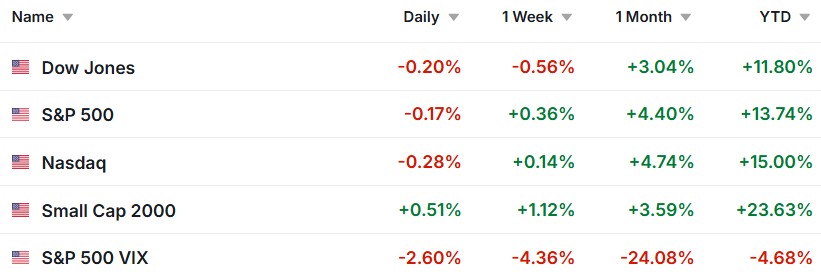
US Market Performance – Week Ending 8/14/26
Exxon Leads Energy, Bitcoin ETFs Gain Traction: Sector Rotation in This Week’s Financial News
Beneath the bond yield headlines, a quiet but notable sector story is developing. Exxon Mobil’s +0.94% gain to $160.10 reflects continued strength in the energy sector as oil prices hold at levels that support solid producer margins. Tesla’s +0.68% tick higher and Alibaba’s +1.35% gain suggest that selective emerging-market and EV exposure continues to attract buyers on any rate-friendly news.
Meta Platforms’ -0.86% pullback, after weeks of outperformance, is a modest reminder that even the best-positioned AI monetization stories are not immune to broader yield-driven pressure on growth multiples. Alphabet’s -0.13% dip is similarly small — a breather after a strong run, not a trend reversal.
Perhaps the most forward-looking development this week is the growing investor attention on two emerging ETF categories: Bitcoin ETFs and AI and Robotics ETFs. Both reflect longer-term structural allocation shifts that are beginning to show up in consistent fund flows. Here is what that trend signals:
- Bitcoin ETFs are maturing as an asset class. Institutional adoption is widening. With Bitcoin near $63,085, the asset is holding above key support levels even as broader risk appetite oscillates. Bitcoin ETFs offer a regulated, accessible way to gain exposure — and that accessibility is drawing capital from investors who would not otherwise hold digital assets.
- AI and Robotics ETFs capture the secular theme broadly. For investors who believe in the AI structural story but want diversification across the hardware, software, and application layers — rather than concentrating in individual names — thematic ETFs are becoming a practical solution. The recent volatility in individual chip and software stocks has reinforced the appeal of broad-basket exposure.
- Sector rotation is reflecting the yield reality. Energy and value-oriented names like Exxon are holding up better in a rising-rate environment than long-duration growth plays. That is not a coincidence — it is the market’s way of adjusting the risk premium in real time.
- Political and policy crosscurrents continue to steer sector leadership. Energy policy, AI governance debates in Congress, and trade dynamics all influence which sectors attract capital and which face headwinds. Diversification across size, style, and sector remains the most reliable insulation against single-policy risk in a fast-moving financial news environment.
The steady positioning framework for late-summer markets: pair selective growth with quality income, watch the yield curve for signals on duration timing, and resist the temptation to make concentrated bets on any single earnings theme or geopolitical outcome. Markets can and do reprice quickly on a single financial news headline.
This Week: Key Economic Data
Monday: No major releases scheduled; Treasury bill auctions; regional Federal Reserve manufacturing surveys
Tuesday: NAHB Housing Market Index (August); U.S. Treasury note auctions
Wednesday: Housing Starts and Building Permits (July); FOMC Minutes (July meeting); EIA Weekly Petroleum Status Report
Thursday: Weekly Jobless Claims; Philadelphia Fed Manufacturing Index (August); Existing Home Sales (July); Conference Board Leading Economic Index (July)
Friday: S&P Global Flash PMIs — Manufacturing and Services (August Preliminary); University of Michigan Consumer Sentiment (Final, August)
This Week: Companies Reporting Earnings
Late-season Q2 reports include retail heavyweights, discount chains, and industrial names that offer a timely read on consumer demand, margins, and the economic backdrop.
- Walmart (WMT)
- Home Depot (HD)
- Target (TGT)
- Lowe’s (LOW)
- TJX Companies (TJX)
- Ross Stores (ROST)
- Keysight Technologies (KEYS)
- Estee Lauder (EL)
- Tapestry (TPR)
- BJ’s Wholesale Club (BJ)
- Jack Henry & Associates (JKHY)
- John Deere (DE)

Tax Tip: How Rising Bond Yields Affect the Tax Treatment of Bond Investments
With the 10-year Treasury yield climbing to 4.696% and the 30-year above 5.266%, many investors are reassessing their fixed-income positions. It is a good time to understand the tax treatment of bonds — because the rules can significantly affect after-tax returns, especially when yields are elevated.
Here are the key tax rules to keep in mind when navigating bond investments in a rising-rate environment:
- Interest income is taxed as ordinary income. Unlike qualified dividends or long-term capital gains, the interest earned from most corporate bonds and Treasury securities is taxed at ordinary income rates — which can reach up to 37% for higher earners, plus the potential 3.8% Net Investment Income Tax (NIIT).
- U.S. Treasury interest is exempt from state and local tax. One advantage of holding Treasuries directly is that interest income is exempt from state and local income taxes — a meaningful benefit in high-tax states.
- Municipal bond interest is generally federal-tax-exempt. For investors in higher tax brackets, tax-exempt municipal bonds may offer a better after-tax yield than their taxable equivalent. Compare the tax-equivalent yield before deciding.
- Capital losses from rising rates can be harvested. If a bond or bond fund has declined in value because rates have risen, that loss can potentially be harvested to offset gains elsewhere in the portfolio — subject to the wash-sale rule.
This information is not a substitute for individualized tax advice. Please consult with a qualified tax professional to discuss your specific tax issues.
Tip adapted from IRS.
Footnotes and Sources
- Investing.com: Real-time market data — Bond yields, ETF prices, leading stocks, futures (August 2026)
- CNBC Finance: Markets and financial news
- Bloomberg Markets: Global market data and analysis
- Wall Street Journal: Markets and earnings coverage
- WSJ Markets: Q2 Earnings calendar
- U.S. Treasury: Daily yield curve rates and auction details
- Federal Reserve: FOMC calendar, statements, and minutes
- NAHB: Housing Market Index
- U.S. Census: New Residential Construction (Housing Starts & Permits)
- NAR: Existing Home Sales
- S&P Global: Flash PMI Releases
- The Conference Board: Leading Economic Index
- U.S. EIA: Weekly Petroleum Status Report
- IRS Tax Topic 403: Interest Received
- IRS Tax Topic 409: Capital Gains and Losses
- IRS Publication 550: Investment Income and Expenses

Wesley Samson
Wesley@samsonfinancial.net
863-345-0538
Samson Financial, LLC.
https://www.samsonfinancial.net