
This week’s financial news arrives with third-quarter earnings season kicking off in earnest, the September inflation report due Wednesday, and Treasury yields near their highest levels in more than two decades. Geopolitics is adding its own crosscurrents, from a preliminary EU-China trade deal to deadly attacks on Riyadh’s airport.
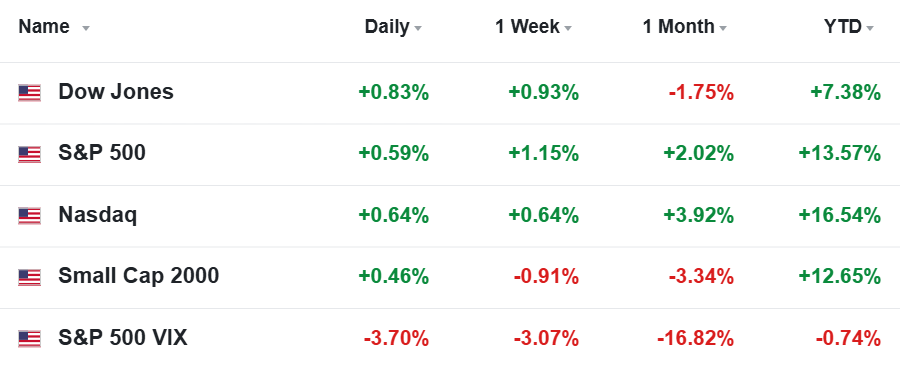
Stocks finished last week on a strong note. For the week ending Friday, October 9, the S&P 500 rose 1.15% to close at 7,811.54, its first record highs since August. The Dow gained 0.93%, and the Nasdaq added 0.64% for its fourth straight weekly gain, while small caps (Russell 2000) slipped 0.91%. Bonds were the bigger story. The 10-year Treasury yield touched about 5.37% on Wednesday, its highest level since 2002, before settling near 5.25% by Friday. Minutes from the Fed’s September meeting, released Wednesday, showed unanimous support for September’s quarter-point rate hike to a 3.75%–4.00% range, with most officials seeing another hike as likely by year-end. This week brings the big banks on Tuesday and Wednesday, the September Consumer Price Index (CPI) on Wednesday, and the Producer Price Index (PPI) and retail sales on Thursday.
Real Treasury Yields and the Equity Valuation Test: What Rising Rates Mean for Portfolios
A BCA Research report dated October 5 puts a critical question in front of every investor: how long can stocks hold up as real Treasury yields climb? Historically, U.S. stocks have held up well even as bond yields rise. The qualifier matters, though. BCA notes that a sustained rise in real yields above the economy’s underlying growth rate is where the math eventually turns unfriendly for equities. In its study, the S&P 500 returned about 11.8% a year when real yields rose but stayed below potential growth, about 8.6% when they crossed above it, and about -1.3% when they started and stayed above it.
Real yields, meaning Treasury yields adjusted for inflation, are now meaningfully positive. The 10-year Treasury yield ended last week near 5.25% after its 24-year high on Wednesday, and the 10-year inflation-protected (TIPS) yield is near 2.9%. That is not inherently dangerous when growth is strong. It becomes a challenge if real yields keep rising faster than the economy can grow, because the risk-free rate becomes more competitive with stock earnings yields and valuation multiples tend to compress.
What the real yield dynamic means for investors right now:
- Growth stock multiples face the most direct pressure. High-multiple names, particularly those whose earnings are weighted toward the future, are most sensitive to rising real yields. The market’s preference for companies with current, demonstrable free cash flow is a rational response.
- Quality income becomes more valuable, not less. When real yields are positive and rising, short-to-intermediate quality bonds and dividend-paying stocks are not a defensive retreat. They are a mathematically sound positioning choice, and cash and short Treasuries remain competitive.
- The Fed’s next move is the key variable. The Fed raised rates in September, and the minutes show most officials expect another hike by year-end. Wednesday’s CPI report will shape expectations heading into the October 27–28 FOMC meeting. A cooler inflation reading could ease pressure on yields; a hot one could push them higher.
- Earnings quality is the best insulation. When the risk-free rate is competitive, the market’s tolerance for disappointment is lower than usual. Companies that beat on revenue, earnings, and free cash flow earn their premium; those that miss or guide cautiously tend to see swift multiple resets.
The practical portfolio takeaway: quality over momentum, income alongside selective growth, and some intermediate duration as a cushion if growth slows. Diversification across size, style, and sector reduces the risk of betting on a single interest-rate scenario.

US Market Performance – Week Ending 10/9/2026
EU-China Trade Tensions and Saudi Energy Headwinds: How Geopolitics Is Shaping Markets
Two geopolitical stories are reshaping the global backdrop, and both have implications for U.S. investors. On Friday, October 9, the European Union and China reached a preliminary trade deal that limits Chinese hybrid and plug-in hybrid car exports to Europe, lowers some duties on EU goods, and eases Chinese export licensing for rare earths and magnets. EU Trade Commissioner Maroš Šefčovič called it only a first step, given a trade imbalance of more than €1 billion a day, and Deutsche Bank described the relationship as at “crunch time” as Brussels pushes for rebalancing.
At the same time, Saudi Arabia is pressing ahead with major energy and investment conferences despite deadly Houthi attacks on Riyadh’s King Khalid International Airport last Thursday, October 8, and again on Saturday, October 10, when Saudi authorities said 12 people were killed and more than 300 injured. The decision signals Riyadh’s intent to project stability and keep its role as a global energy and investment hub. It also adds a new layer of risk to Middle East energy supply.
Here is how these developments are threading into markets and portfolios:
- EU-China trade friction adds to supply chain uncertainty. European companies with significant China revenue, and U.S. multinationals with EU and China manufacturing ties, face a more complex operating environment if talks stall. Earnings guidance from globally exposed companies this season deserves extra scrutiny for any trade-related caution.
- Saudi security matters to oil markets. Any significant disruption to Saudi production or export capacity would be a major market event. For now, the attacks add to a war risk premium that has kept crude elevated for months.
- The Iran war remains the dominant energy driver. WTI crude settled near $90 a barrel on Friday and Brent near $103, slipping late in the week after President Trump said the U.S. would not strike Iran before the November 3 midterm elections. With WTI up roughly 59% this year, energy costs remain a key input for the inflation outlook.
- Gold remains a favored hedge. Gold futures rose about 1.5% on Friday to roughly $4,220 an ounce, consistent with a market seeking diversification as long-term bond yields climb and geopolitical stress persists.
The steady positioning framework: avoid concentrated bets on any single geopolitical outcome. Balanced exposure across energy, quality growth, and income assets helps absorb shocks that can arrive without warning, as last week’s airport attacks demonstrated. A diversified plan travels better than a geopolitical thesis.
This Week: Key Economic Data
Monday: Columbus Day — bond markets closed, stock markets open; no major U.S. economic data
Tuesday: NFIB Small Business Optimism Index (September); Existing Home Sales (September)
Wednesday: Consumer Price Index (CPI) for September — the week’s most market-critical inflation release; Real Earnings (September); Federal Reserve Beige Book
Thursday: Weekly Jobless Claims; Producer Price Index (PPI) for September; Retail Sales (September); Empire State Manufacturing Survey (October); Philadelphia Fed Manufacturing Index (October); EIA Weekly Petroleum Status Report (delayed a day by the holiday)
Friday: Import and Export Price Indexes (September); Industrial Production and Capacity Utilization (September)
Looking ahead: the final October University of Michigan Consumer Sentiment reading arrives Friday, October 23, and the Fed’s next policy decision follows its October 27–28 meeting.
This Week: Companies Reporting Earnings
Third-quarter earnings season kicks into high gear as the nation’s largest banks report on Tuesday and Wednesday, joined by health care leaders and two key semiconductor companies, ASML and TSMC.
- JPMorgan Chase (JPM) — Tuesday, October 13
- Goldman Sachs (GS) — Tuesday, October 13
- Wells Fargo (WFC) — Tuesday, October 13
- Citigroup (C) — Tuesday, October 13
- Johnson & Johnson (JNJ) — Tuesday, October 13
- UnitedHealth Group (UNH) — Tuesday, October 13
- Bank of America (BAC) — Wednesday, October 14
- Morgan Stanley (MS) — Wednesday, October 14
- BlackRock (BLK) — Wednesday, October 14
- ASML Holding (ASML) — Wednesday, October 14
- Taiwan Semiconductor Manufacturing Co. (TSM) — Thursday, October 15
- Charles Schwab (SCHW) — Thursday, October 15
- PNC Financial (PNC) — Thursday, October 15
- U.S. Bancorp (USB) — Thursday, October 15
- Travelers (TRV) — Friday, October 16
Looking ahead: Netflix, Intuitive Surgical, and United Airlines report Tuesday, October 20; Abbott Laboratories on Wednesday, October 21; Procter & Gamble on Thursday, October 22; and American Express on Friday, October 23.

Tax Tip: Use Q4 to Strategically Harvest Losses Before Year-End
October marks the opening of the year’s most valuable tax-planning window. With Q3 behind us and meaningful volatility across sectors — from chip stocks to long-duration bonds — many portfolios are carrying a mix of unrealized gains and losses that can be actively managed before December 31. Tax-loss harvesting is one of the most impactful strategies available to taxable investors. Realized losses can offset capital gains dollar-for-dollar, and net losses beyond gains can offset up to $3,000 of ordinary income annually ($1,500 if married filing separately), with any remainder carrying forward to future years.
Three rules to execute correctly in consultation with a tax professional:
- Mind the wash-sale rule. The IRS disallows a realized loss if the same or a substantially identical security is purchased within 30 days before or after the sale. Replacing a sold position with a similar — but not substantially identical — fund can maintain market exposure while preserving the tax benefit.
- Identify your highest-cost lots. Instruct the custodian to use “specific identification” when selling, matching the sale to the highest-cost shares. This maximizes the realized loss.
- Match loss types to gain types. Short-term losses offset short-term gains first; long-term losses offset long-term gains first. Coordinate the order of sales to maximize the after-tax benefit — especially if some positions crossed the one-year holding threshold this year.
This information is not a substitute for individualized tax advice. Please consult with a qualified tax professional to discuss your specific tax issues.
Tip adapted from IRS.
Footnotes and Sources
- Investing.com: Major Indices performance — Dow Jones, S&P 500, Nasdaq, Small Cap 2000, VIX (Friday close, October 9, 2026)
- Yahoo Finance: Markets News, Oct. 9, 2026 — Stocks rise as oil prices, Treasury yields stabilize
- Investing.com: Where could stocks and bonds collide? Here’s what to watch (BCA Research, October 5, 2026)
- Forbes: Why the 10-year Treasury yield just hit a 24-year high (October 7, 2026)
- LPL Research: Weekly Market Performance, October 9, 2026
- Federal Reserve: FOMC calendar, minutes, and monetary policy resources
- Investing.com: EU-China trade relations hit crunch time as Brussels pushes for rebalancing (October 10, 2026)
- NPR: Attack on Riyadh airport killed 12 people and wounded over 300, Saudi authorities say (October 10, 2026)
- Reuters via U.S. News: Major Saudi conferences to proceed despite deadly airport attack (October 10, 2026)
- Bureau of Labor Statistics: October 2026 release schedule (CPI, PPI, Import/Export Prices)
- U.S. Census Bureau: 2026 Economic Indicator Calendar (Retail Sales)
- Federal Reserve: October 2026 calendar (Beige Book, Industrial Production)
- National Association of Realtors: Existing Home Sales
- U.S. EIA: Weekly Petroleum Status Report schedule
- JPMorgan Chase: Third-quarter 2026 earnings call announcement
- Morgan Stanley: Third-quarter 2026 investor conference call
- TSMC: Quarterly results
- Netflix: Third-quarter 2026 results announcement
- WSJ Markets: Q3 Earnings calendar
- IRS Tax Topic 409: Capital Gains and Losses
- IRS Publication 550: Investment Income and Expenses (wash sales)

Wesley Samson
Wesley@samsonfinancial.net
863-345-0538
Samson Financial, LLC.
https://www.samsonfinancial.net