
This week’s financial news is led by the Federal Reserve’s first rate hike in three years, a new SEC exemption for tokenized stock trading, and JPMorgan admitting it cannot model where oil goes next. Add a failed crypto bill in the Senate and a Bitcoin rebound back above $81,000, and it was anything but a quiet week. Yahoo Finance
The Fed Raises Rates for the First Time Since 2023: What It Means for Markets and Your Money: On Wednesday, September 16, the Federal Reserve voted 12-0 to raise its target range for the federal funds rate by a quarter point, to 3.75%-4.00%. It was the Fed’s first rate hike since July 2023. Updated projections show 16 of the 18 officials who submitted them expect another increase, with a few seeing two more. As of Friday morning, futures pricing showed roughly a 55% chance of another hike at the October 28 meeting and 90% by December 9. Federal Reserve Board – Federal Reserve issues FOMC statement +3
Inflation drove the decision. August CPI, released September 11, rose 0.4% for the month and 3.4% from a year ago. Core prices rose 0.3% on the month, a bit hotter than expected, and energy prices were up 16.3% year over year. The preliminary University of Michigan sentiment reading fell to 47.8, the second-lowest on record, while year-ahead inflation expectations rose to 4.6%. August CPI inflation: Consumer price growth remained elevated | Fox Business +2
What the hike means right now:
- Borrowing costs are climbing. The 30-year fixed mortgage averaged 6.95% as of September 17, up from 6.76% a week earlier. That is the highest since January 2025 and the fourth straight weekly increase. The 10-year Treasury yield reached roughly 5% this week, its highest in about three years. Mortgage Rates – Freddie Mac +2
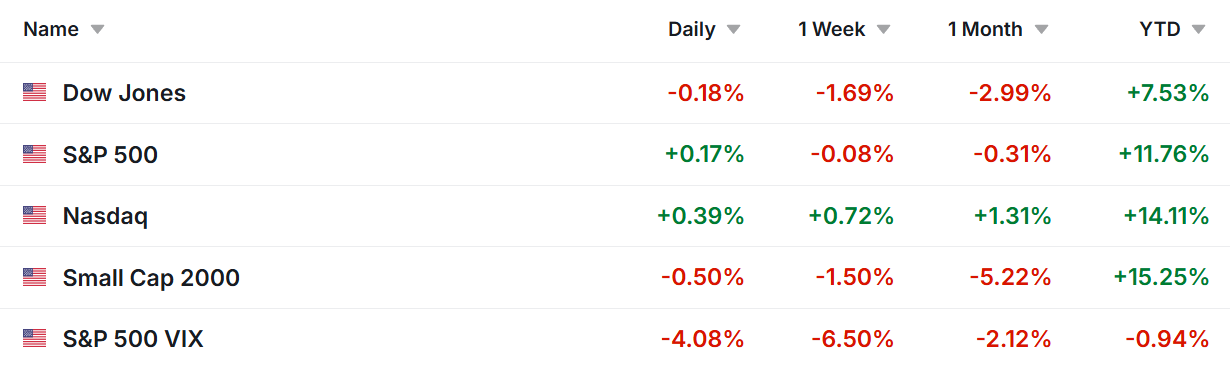
- Stocks are divided. Transports, small caps, industrials and consumer discretionary stocks have each fallen for five or more straight weeks, while technology has held up better. Investrade
- Savers and borrowers feel it differently. Higher short-term rates can improve yields on cash and short-term savings, while variable-rate debt such as credit cards becomes more expensive.
SEC Opens a Five-Year Window for Tokenized Stock Trading
On Thursday, September 17, the SEC issued its long-awaited innovation exemption, opening a five-year path for tokenized stock trading. The order gives temporary, conditional relief to tokenized securities venues so they can trade tokenized exchange-listed stock using permissioned automated market makers and liquidity pools. Qualifying liquidity providers receive a separate dealer exemption. SEC Opens Five-Year Path for Tokenized Stock Trading, With Limits +2
This is a meaningful step, but it is narrower than some headlines suggest:
- Limited in scope. A venue may list at most 75 large-cap symbols, with trading in each capped at 0.25% of the stock’s average daily volume. Smaller stocks fall into a 250-symbol, 2.5% tier. Trading must stop when the underlying stock is halted on its primary exchange. ForbesStockInvest
- Real shares only. Venues must be US persons, synthetic versions of stocks are prohibited, and issuers are notified and can opt out. Token holders must receive the same rights and privileges as holders of the equivalent class of traditional stock. American BankerYahoo Finance
- Benefits are potential, not proven. Tokenization could eventually enable 24/7 trading, but thinner off-hours activity can bring more volatility and larger price swings. US stocks already moved to next-day (T+1) settlement in 2024, so the gain from tokenized settlement would be a move toward near-instant. CNBC
- Not permanent. Commissioner Hester Peirce described the measure as an interim experiment while the SEC develops a more durable framework. Industry insiders note that agency actions can be changed more easily than legislation. StockInvestAmerican Banker
Crypto policy and markets this week:
- The CLARITY Act stalled. The Senate voted down a motion to advance the crypto market-structure bill on September 15. SEC Chairman Paul Atkins acknowledged Congress’s setback when announcing the exemption. Yahoo FinanceForbes
- Bitcoin rebounded. Bitcoin dipped to around $76,000 after the Senate vote and the Fed hike, then recovered above $81,000 by September 18. That is a gain of about 6% from roughly $75,000 on the eve of the Fed decision. Yahoo FinanceYahoo Finance
- CFTC seats remain empty. The White House has vetted candidates for four open CFTC commissioner seats, but the chairman is the only sitting member and the timing of nominations is unclear. The vacancies have been a sticking point in the CLARITY Act debate. CNBCYahoo Finance
- Visa expanded blockchain lending data. On September 8, Visa said it will pair its settlement data with onchain lending infrastructure as stablecoin-linked card programs surpass 160. The lending use case is currently a North America pilot. CNBCYahoo Finance
US Market Performance – Week Ending 9/18/2026
JPMorgan Has No Oil Baseline as Iran War Escalates: What It Means for Financial News and Your Portfolio
JPMorgan said that for the first time since the start of the US-Israeli war on Iran, it has no clear baseline view for oil markets. The bank had assumed that oil above $100, gasoline near $5 and a 10-year Treasury yield above 5% would push Washington toward a deal to reopen the Strait of Hormuz by June. Those thresholds have been crossed, and an interim deal in June collapsed back into fighting. US diesel has hit a record $6.31 a gallon. JP Morgan Says It Has No Clear Oil Market Endgame as Iran Conflict Drags On +2
Roughly a fifth of the world’s oil normally moves through Hormuz, and the disruption is no longer hypothetical. Hormuz remains far from normal, Saudi Arabia’s bypass pipeline is shut, and Houthi involvement has deepened Red Sea disruptions. JPMorgan puts Brent’s September fair value near $90, against futures near $103 on September 18. That gap implies the market is pricing another 3 to 4 million barrels a day of lost supply on top of roughly 10 million already disrupted. Inventories and weaker demand are what have kept oil from surging past $120. Adding to the uncertainty, President Trump said he is nearing a decision on whether to restart major combat operations or end the war. JPMorgan Says It ‘Honestly Doesn’t Know’ Oil Outlook as Iran War Exit Grows Murkier; China Is the Last Card +3
How the Iran-oil-inflation triangle affects investors:
- Oil is a direct inflation input. With CPI at 3.4% and the Fed now raising rates, a sustained war premium in crude makes the Fed’s job harder.
- Energy earnings guidance is unreliable. When JPMorgan cannot model a base case, producers and refiners face the same problem. Treat overly confident forward projections with caution.
- Defense and aerospace spending. Prolonged conflict has historically supported defense budgets, though valuations still matter.
- Diversification matters. Outcomes range from a negotiated de-escalation that sends oil lower to a deeper supply disruption that sends it sharply higher. Concentrated bets in either direction carry elevated risk, and balance and quality remain the sensible response to a wide range of outcomes.
Around the World: Bond Markets Under Pressure
The Bank of England paused gilt sales for six months and halted sales of long-dated gilts entirely, setting a multi-year plan to offload most of its £488 billion portfolio by 2034. This came days after UK 30-year borrowing costs hit their highest since 1998. The BoE held rates at 3.75%, while the Bank of Japan raised rates to 1.25%. Investing.comBabypips
This Week: Key Economic Data (September 21-25)
The calendar is light on reports but heavy on Fed speakers, with roughly ten appearances as investors look for hints on the path of rates. The next CPI report is October 14. KiplingerU.S. Bureau of Labor Statistics
- Monday: No major releases; Chicago Fed President Goolsbee speaks Kiplinger
- Tuesday: Fed speakers Williams, Jefferson and Barkin Kiplinger
- Wednesday: S&P Global flash manufacturing and services PMIs (September); Fed Governor Barr speaks Kiplinger
- Thursday: Weekly jobless claims; new home sales (August); Fed speakers Williams, Hammack and Paulson Kiplinger
- Friday: Durable goods (August); University of Michigan consumer sentiment, final September reading; Fed speakers Williams and Hammack Kiplinger
Also in focus: Chinese President Xi’s state visit to the US, with a Trump-Xi summit expected September 24. NewsquawkGround News
This Week: Companies Reporting Earnings
Homebuilding, food, restaurant and retail names offer early reads on housing demand and consumer spending under higher rates and fuel costs. kiplinger
- Tuesday, 9/22: AutoZone (AZO) before the open; KB Home (KBH) after the close kiplinger
- Wednesday, 9/23: General Mills (GIS), Cintas (CTAS), Paychex (PAYX) and Cracker Barrel (CBRL) before the open kiplinger
- Thursday, 9/24: Darden Restaurants (DRI) before the open; Costco (COST) and FedEx Freight (FDXF) after the close kiplinger
Tax Tip: Keep Well-Organized Records — The IRS Has Longer Memories Than You Think
With tax complexity increasing alongside inflation, investment gains, and new asset classes like tokenized securities, now is the right time to revisit a foundational tax principle: recordkeeping. According to the IRS, taxpayers are encouraged to retain receipts, canceled checks, and other documents that support income, deductions, or credits for as long as those records may be material to the administration of any tax provision.
The statutes of limitation for IRS assessment range from three to seven years — and in cases of fraud or failure to file, there is no limit at all. For property records (including real estate, stocks, and increasingly, digital assets like tokenized securities), records should be kept for as long as ownership continues, plus the relevant assessment period after disposition. A few practical steps to get organized now:
- Document all investment transactions. This includes purchase dates, cost basis, and sale proceeds — for stocks, bonds, mutual funds, ETFs, and any blockchain-based or digital assets acquired.
- Retain property records through ownership and beyond. Improvements to real estate, inherited asset valuations, and capital gain calculations all depend on records that may span decades.
- Keep healthcare and business records. Medical expense deductions, home office claims, and business income all require substantiation that should be organized and accessible.
This information is not a substitute for individualized tax advice. Please consult with a qualified tax professional to discuss your specific tax issues.
Tip adapted from IRS.
Footnotes and Sources
- Reuters Finance: SEC unveils blockchain/tokenized stock trading exemption (September 2026)
- Reuters Finance: JPMorgan has no clear oil baseline amid US-Israeli war on Iran (September 2026)
- Reuters Finance: Bank of England halts gilt sales, sets 2034 timeline for portfolio offload
- CNBC Finance: Visa expands blockchain data offering for lenders (September 8, 2026)
- CNBC Finance: Bitcoin heads for third winning week in a row as macro pressures mount (September 4, 2026)
- CNBC Finance: White House has vetted candidates for key CFTC vacancies (September 6, 2026)
- CNBC Finance: How one hedge-fund manager built his firm entirely powered by AI agents (September 9, 2026)
- CNBC Finance: Sugar is outperforming the stock market this year (September 6, 2026)
- Federal Reserve: FOMC calendar and monetary policy resources
- Bureau of Labor Statistics: Consumer Price Index (CPI)
- Bureau of Labor Statistics: Producer Price Index (PPI)
- NFIB Research Center: Small Business Optimism Index
- University of Michigan: Surveys of Consumers
- U.S. EIA: Weekly Petroleum Status Report
- U.S. Treasury: Daily yield curve rates and auction details
- WSJ Markets: Earnings calendar
- IRS: How Long Should I Keep Records?

Wesley Samson
Wesley@samsonfinancial.net
863-345-0538
Samson Financial, LLC.
https://www.samsonfinancial.net