

The calendar features January’s CPI and PPI, retail sales, and industrial production, all while policy headlines, oil moves, and Treasury supply continue to sway yields and risk appetite. The market still rewards quality—steady cash flow, margin discipline, and clean capital allocation—especially when the financial news can change before lunch.
Inflation Reset: CPI, Yields, and Market Breadth in Financial News
Inflation sits center stage. The Consumer Price Index (CPI) and Producer Price Index (PPI) will shape the near‑term path for rates and sector leadership. Cooler core readings support a steadier policy path and can pull long yields lower. Hotter services inflation keeps “higher‑for‑longer” in the mix a bit longer.
Here are the practical read‑throughs for portfolios:
- Lower long yields tend to support housing, utilities, and select REITs.
- If services inflation stays sticky, cash and short Treasuries remain competitive.
- Should disinflation continue without undercutting growth, equity leadership can broaden beyond a narrow cohort.
- Intermediate duration can regain its hedging role if growth cools gradually.
Retail sales will add a real‑time read on the consumer. Promotions can lift volumes while pressuring average selling prices. Companies with healthy inventories, clean execution, and recurring revenue usually find more forgiving multiples. That selectivity remains a defining feature of this phase of the financial news cycle.
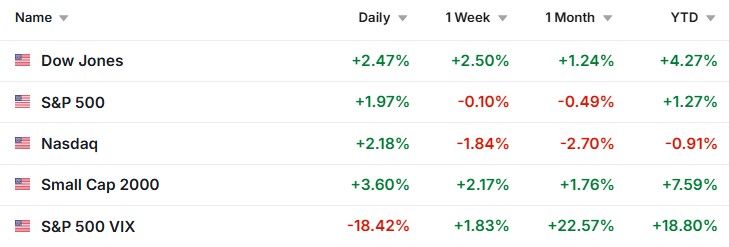
US Market Performance – Week Ending 2/6/2026
Policy Crosscurrents: Budget, Oil, and Regulation in Financial News
Politics is not the whole story. It does steer parts of it. Government funding steps and deficit dynamics influence Treasury issuance, term premiums, and rate volatility. A smoother budget path tends to calm long‑end yields. A noisier path can keep them sticky, affecting mortgages, credit spreads, and equity valuation ranges.
Energy remains the swing factor. OPEC+ communications and U.S. inventory trends can push crude oil around. Oil swings often filter into headline inflation and—by extension—rate expectations. That feedback loop touches airlines, refiners, transportation, and consumers’ purchasing power.
Regulatory talk around large‑cap tech, data privacy, AI governance, and consumer finance can also nudge sector multiples and capital return plans. Diversification across size, style, and sector helps reduce single‑policy risk—useful when headlines zig on Tuesday and zag on Thursday in the financial news cycle.
This Week: Key Economic Data
- Monday, February 9, 2026
- Limited major releases.
- Consumer Inflation Expectations (NY Fed, January) around 11:00 a.m. ET (secondary gauge of household views on inflation).
- Some Fed speakers (e.g., potential Bostic or others).
- Wholesale Inventories (final December) may appear in some calendars around 10:00 a.m. ET.
- Tuesday, February 10, 2026
- Employment Cost Index (ECI) for Q4 2025 at 8:30 a.m. ET (key wage inflation measure, watched closely for Fed policy signals).
- U.S. Import and Export Price Indexes (December 2025) at 8:30 a.m. ET (trade-related inflation pressures).
- Retail Sales (December 2025) at 8:30 a.m. ET (consumer spending gauge; consensus expects ~0.5% m/m rise).
- Other possibles: Business Inventories (November).
- Wednesday, February 11, 2026
- Employment Situation (Nonfarm Payrolls / Jobs Report) for January 2026 at 8:30 a.m. ET (high impact; consensus ~70K jobs added, unemployment ~4.4%, hourly earnings +0.3% m/m). Delayed from original early-February date.
- Treasury Statement / Budget Balance (January) around 2:00 p.m. ET (fiscal update).
- Thursday, February 12, 2026
- Producer Price Index (PPI) for January 2026 at 8:30 a.m. ET (wholesale inflation; often a precursor to CPI trends).
- Existing Home Sales (January) at 10:00 a.m. ET (housing market health; consensus ~4.25 million annualized rate).
- Possible other housing or regional data.
- Friday, February 13, 2026
- Consumer Price Index (CPI) for January 2026 at 8:30 a.m. ET (headline inflation; high impact, consensus ~0.3% m/m, core ~0.3%).
- Real Earnings (January) at 8:30 a.m. ET (wage growth adjusted for inflation).
- Note: Some sources had confusion around Feb 11 vs. 13 for CPI, but BLS confirms Jan data on Feb 13 at 8:30 a.m. ET (with Employment on Feb 11).
This Week: Companies Reporting Earnings
Based on major earnings calendars, the following widely watched companies are scheduled to report this week. Dates can shift; check company investor relations pages for final timing.
Monday, February 9
- Cleveland-Cliffs (CLF) – Steel/industrials bellwether
- onsemi (ON) – Semiconductors (key for auto/tech supply chain)
- Other notables: Becton Dickinson (BDX) – Medical devices
Tuesday, February 10
- Coca-Cola (KO) – Major consumer staples/blue-chip (global pricing power proxy)
- Ford (F) – Automotive/manufacturing indicator
- Robinhood (HOOD) – Fintech/retail trading
- Datadog (DDOG) – Cloud/software
- Spotify (SPOT) – Streaming/tech
- Gilead Sciences (GILD) – Biotech/pharma
- Cloudflare (NET) – Cybersecurity/cloud
- Lyft (LYFT) – Ride-sharing
- BP (ADR) – Energy
Wednesday, February 11
- McDonald’s (MCD) – Consumer/restaurants (fast-food bellwether)
- Cisco Systems (CSCO) – Networking/tech (enterprise focus)
- CVS Health (CVS) – Healthcare/pharmacy retail
- Shopify (SHOP) – E-commerce/tech
- T-Mobile (TMUS) – Telecom
- Kraft Heinz (KHC) – Consumer packaged goods
- Vertiv (VRT) – Data center/infrastructure
Thursday, February 12
- Heavier overall volume (often 200+ reports), but fewer standalone mega-headliners highlighted in previews. Focus shifts to mid-caps and sector-specific names (e.g., industrials, financials, additional tech/healthcare). Check full calendars for specifics like Applied Materials (AMAT) or others if relevant.
Friday, February 13
-
- Lightest day (typically 20–30 reports). Mostly smaller caps or wrap-up names; limited major movers expected.

Tax Tip: Still Time to Fund Last Year’s IRA or HSA
There is often still time to make prior‑year IRA and HSA contributions up to the federal filing deadline (generally mid‑April). This can boost tax advantages and fill savings gaps discovered during tax prep. Confirm eligibility (including spousal IRA rules), understand how Roth phase‑outs and the pro‑rata rule affect conversions, and keep contribution confirmations for records. Coordinate with a tax professional before acting.
This information is not a substitute for individualized tax advice. Please consult with a qualified tax professional to discuss your specific tax issues.
Tip adapted from IRS.
Footnotes and Sources
- Bureau of Labor Statistics: Consumer Price Index (CPI)
- Bureau of Labor Statistics: Producer Price Index (PPI)
- U.S. Census Bureau: Advance Monthly Retail Sales
- Federal Reserve: Industrial Production & Capacity Utilization (G.17)
- University of Michigan: Surveys of Consumers
- U.S. Department of Labor: Unemployment Insurance Weekly Claims
- U.S. Treasury: Daily yield curve rates and auction details
- WSJ Markets: Earnings calendar
- U.S. EIA: Weekly Petroleum Status Report
- CNBC Finance: Markets and financial news
- Bloomberg Markets: Global market data and analysis
- IRS Publication 969: HSAs and Other Tax‑Favored Health Plans
- IRS: IRA deduction and contribution basics

Wesley Samson
Wesley@samsonfinancial.net
863-345-0538
Samson Financial, LLC.
https://samsonfinancial.net