
This week’s financial news centers on Tuesday’s midterm elections, Friday’s October jobs report, and another busy week of earnings, led by Apple on Monday and AMD on Tuesday.
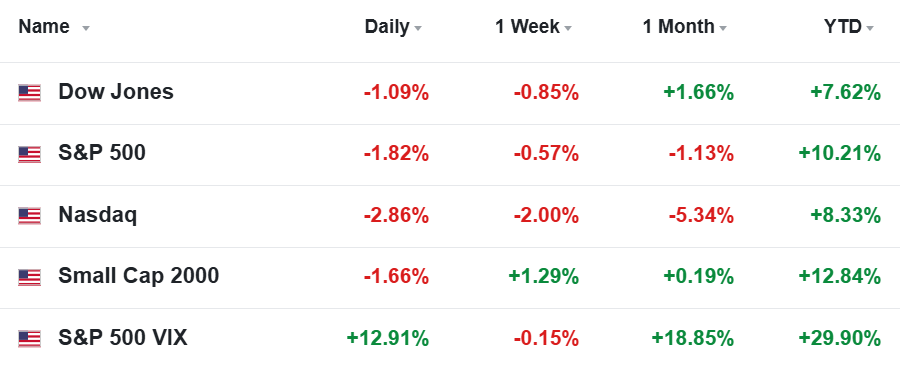
Stocks fell last week. For the week ending Friday, October 30, the S&P 500 slipped 0.57% to 7,580.07, the Nasdaq fell 2.00% to 25,437.00 and the Dow lost 0.85% to 51,770.31, as Big Tech earnings revived worries about the cost of the AI spending race. Small caps (Russell 2000) bucked the trend with a 1.29% gain. The VIX volatility index ended at 19.42. For October, the Nasdaq fell 5.34%, its worst month since March 2025. Oil stayed high: WTI crude settled at $104.12 on Friday, and Brent rose 13.6% in October. The 10-year Treasury yield ended the week near 4.9%.
Big Tech’s AI Spending Test: Microsoft Passes, Alphabet and Amazon Stumble
Last week’s biggest market story was the busiest stretch of third-quarter earnings season, and once again the market graded AI on cash flow, not just growth. Alphabet and Microsoft reported on Wednesday, October 28, and the reactions could not have been more different.
Alphabet’s revenue rose 25% to $127.6 billion and Google Cloud revenue more than doubled, but earnings fell well short of forecasts, partly because of an $8.7 billion loss on its investments, including its SpaceX stake. Capital spending rose to $51.3 billion for the quarter and free cash flow was negative for a second straight quarter. The stock fell nearly 13% on Thursday, its worst day since its 2004 IPO. Microsoft beat expectations: revenue rose 19% to $92.3 billion, its Azure cloud business grew 48%, and it stayed solidly cash-flow positive. Its shares rose. Amazon, which reported Thursday, missed on revenue and earnings and spent more than expected, though its AWS cloud unit grew 39%. Then on Friday, Intel fell 28.6%, its worst day since 1974, after a weak fourth-quarter forecast. The Nasdaq dropped 2.86% and the S&P 500 1.82% that day, both their worst days since June.
What last week’s moves signal for investors:
- Spending must show a payoff. Microsoft was rewarded because its heavy AI investment is already producing fast-growing cloud revenue and positive free cash flow. Companies whose spending is running ahead of their cash flow are being punished quickly.
- Overall earnings remain strong. With about 60% of S&P 500 companies reported, third-quarter earnings are up about 30% from a year ago, and 82% of companies have beaten estimates.
- Leadership is broadening. The Magnificent 7 fell about 2.2% for the week, while the average S&P 500 stock rose about 0.8% and small caps gained 1.29%.
- Volatility is concentrated in tech. Large one-day moves in chip and AI stocks are likely to continue as investors sort winners from laggards.
The practical takeaway: AI remains a powerful long-term theme, but last week is a reminder that it should be one part of a diversified portfolio rather than the whole plan.

US Market Performance – Week Ending 10/30/2026
A Split Fed, Strong Growth and Election Week: What to Watch
The Federal Reserve held its benchmark rate steady at 3.75%–4.00% on Wednesday, October 28, as expected. But the vote was 10–2: Governor Lisa Cook and Cleveland Fed President Beth Hammack dissented in favor of another quarter-point hike. Chair Kevin Warsh said inflation “remains elevated” and gave no firm signal on December, and he said politics played no role in the decision. Futures markets are pricing a strong chance of a hike at the Fed’s next meeting, which ends December 9.
The data gave both sides something to point to. On Thursday, the first estimate showed the economy grew at a strong 3.4% annual rate in the third quarter. But September’s Personal Consumption Expenditures (PCE) price index, the Fed’s preferred inflation gauge, was up 3.6% from a year earlier, with core PCE up 3.1%, still well above the Fed’s 2% goal. With oil above $100 a barrel, energy costs remain a key inflation risk.
What to watch this week:
- Tuesday’s midterm elections. Control of Congress will shape the outlook for spending, taxes, energy and defense policy. Markets often react in the days after an election as uncertainty clears, but history suggests election outcomes matter less for long-term returns than earnings and interest rates.
- Friday’s jobs report. Economists expect October payrolls to rise by about 65,000, with unemployment holding at 4.2%. A strong report would add to the case for a December hike.
- More AI earnings. Apple reports Monday and AMD on Tuesday, giving investors another read on whether AI spending is turning into profits.
- Oil and yields. Higher energy prices and a 10-year yield near 4.9% continue to set the tone for rate-sensitive stocks and bonds.
The steady framework: some energy exposure as a partial inflation hedge, quality income as a core, some intermediate-duration bonds, and avoiding concentrated bets on any single election or Fed outcome. A week with an election, a jobs report and big earnings is a time to rely on a balanced plan, not to react to every headline.
This Week: Key Economic Data
Monday: ISM Manufacturing Index (October); Construction Spending (September)
Tuesday: Midterm elections; Job Openings and Labor Turnover Survey (JOLTS, September); Factory Orders (September)
Wednesday: ADP National Employment Report (October); U.S. Trade Balance (September); ISM Services Index (October); EIA Weekly Petroleum Status Report
Thursday: Weekly Jobless Claims; Productivity and Costs (Q3, preliminary); Federal Reserve balance sheet
Friday: Employment Situation (October): Nonfarm Payrolls, Unemployment Rate, Average Hourly Earnings
Looking ahead: the Consumer Price Index (CPI) for October arrives Tuesday, November 10, and the Producer Price Index (PPI) follows Friday, November 13. Minutes from the Fed’s October meeting are due Wednesday, November 18.
This Week: Companies Reporting Earnings
Another busy week of third-quarter results, led by Apple, Palantir and AMD, with a broad mix of travel, payments, healthcare and delivery names.
- Apple (AAPL) — Monday, November 2
- Palantir Technologies (PLTR) — Monday, November 2
- Roku (ROKU) — Monday, November 2
- Pfizer (PFE) — Tuesday, November 3
- Shopify (SHOP) — Tuesday, November 3
- AMD (AMD) — Tuesday, November 3
- Booking Holdings (BKNG) — Tuesday, November 3
- Uber Technologies (UBER) — Wednesday, November 4
- CVS Health (CVS) — Wednesday, November 4
- Qualcomm (QCOM) — Wednesday, November 4
- DoorDash (DASH) — Wednesday, November 4
- Airbnb (ABNB) — Thursday, November 5
- Moderna (MRNA) — Friday, November 6

Tax Tip: Year-End Loss Harvesting — Three Rules Before December 31
With December 31 approaching faster than it seems, tax-loss harvesting is one of the most time-sensitive strategies available to taxable investors. In a year with sharp swings in AI and chip stocks, long-term bonds and energy, many portfolios are carrying a mix of unrealized gains and losses that can be managed before year-end.
Realized losses offset capital gains dollar-for-dollar. Net losses beyond current-year gains can offset up to $3,000 of ordinary income annually ($1,500 if married filing separately), with any unused amount carrying forward to future tax years. Three rules to follow, in consultation with a qualified tax professional:
- Respect the wash-sale rule. The IRS disallows a loss if the same or a substantially identical security is purchased within 30 days before or after the sale. Replacing a sold position with a similar, but clearly different, fund can maintain market exposure while preserving the tax benefit.
- Use specific lot identification. Instructing the custodian to sell the highest-cost shares first can maximize the realized loss today.
- Match loss types strategically. Short-term losses offset short-term gains first; long-term losses offset long-term gains first. Because short-term gains are taxed at ordinary income rates (up to 37%) and long-term gains at 0%, 15% or 20%, the order can make a meaningful difference.
This information is not a substitute for individualized tax advice. Please consult with a qualified tax professional to discuss your specific tax issues.
Tip adapted from IRS.
Footnotes and Sources
- Investing.com: Major Indices performance — Dow Jones, S&P 500, Nasdaq, Small Cap 2000, VIX (Friday close, October 30, 2026)
- StockTitan: Tech stocks fall as Intel has its worst day in decades (October 30, 2026)
- Investrade: Market Review, October 30, 2026
- 24/7 Wall St.: Alphabet sinks as AI spending pushes cash flow negative again; Microsoft edges higher (October 29, 2026)
- Yahoo Finance: Alphabet loses $475 billion in market value, the biggest drop in its history (October 29, 2026)
- IndexBox: September 2026 PCE — headline 3.6%, core 3.1%
- Federal Reserve: FOMC statement and vote (October 28, 2026)
- Forbes: Earnings jump 30% as AI divides Big Tech winners and losers (October 31, 2026)
- MarketScreener: December WTI crude settles at $104.12 per barrel (October 30, 2026)
- The Nation: Brent ends October up 13.6%
- Yahoo Finance: Fed holds rates steady in split vote (October 28, 2026)
- Federal Reserve: Chair Warsh’s press conference transcript (October 28, 2026)
- Bureau of Economic Analysis: GDP (Advance Estimate), 3rd Quarter 2026
- StockTitan: U.S. GDP grew 3.4% in the third quarter; September PCE inflation
- Bureau of Labor Statistics: November 2026 release schedule (JOLTS, Productivity and Costs, Employment Situation, CPI, PPI)
- U.S. Census Bureau: 2026 Economic Indicator Calendar (Construction Spending, Factory Orders, International Trade)
- ISM: Manufacturing and Services Reports on Business
- ADP: National Employment Report
- U.S. EIA: Weekly Petroleum Status Report schedule
- StockTitan: Earnings calendar for the week of November 2, 2026
- Apple fiscal Q4 2026 earnings on November 2
- Palantir: Third-quarter 2026 earnings release date
- Roku: Third-quarter 2026 results on November 2
- Pfizer: Third-quarter 2026 earnings call
- Shopify: Third-quarter 2026 results date
- AMD: Fiscal third-quarter 2026 results date
- Booking Holdings: Third-quarter 2026 results on November 3
- Uber: Third-quarter 2026 results conference call date
- CVS Health: Third-quarter 2026 earnings conference call
- Qualcomm: Fiscal fourth-quarter 2026 earnings release date
- DoorDash: Third-quarter 2026 results on November 4
- Airbnb: Third-quarter 2026 results date
- Moderna: Third-quarter 2026 results on November 6
- IRS Tax Topic 409: Capital Gains and Losses
- IRS Publication 550: Investment Income and Expenses (wash sales and lot identification)

Wesley Samson
Wesley@samsonfinancial.net
863-345-0538
Samson Financial, LLC.
https://www.samsonfinancial.net